|
Chronological List of District Heating
Systems in the United States |
|
|
| Minnegasco
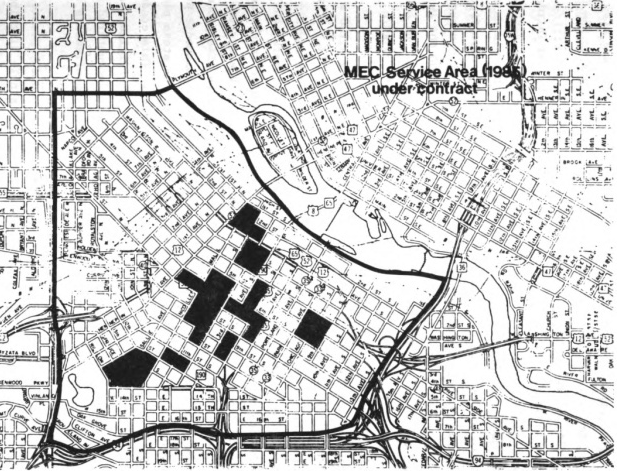
Energy Center proposed area to be under contract in 1985 |
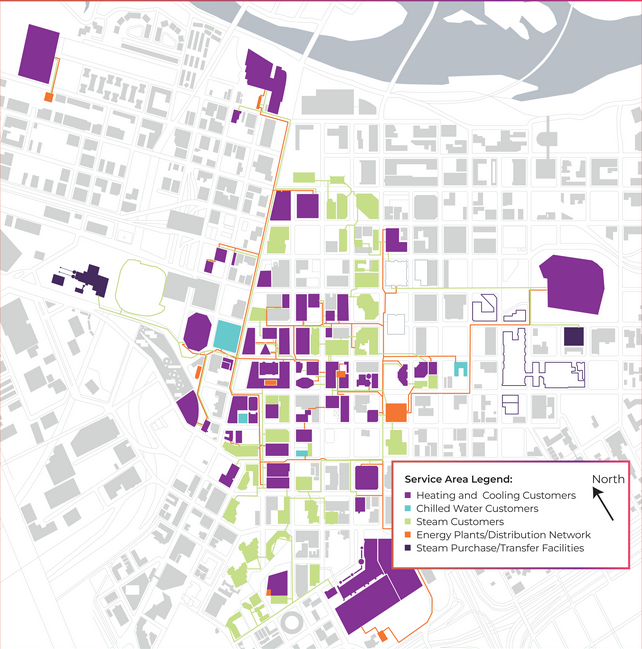
Cordia's current service area |
Baker Properties owned several buildings in downtown Minneapolis and built a heating plant in 1927 to provide heating for them and other nearby buildings. The company was sold to IDS Properties in 1969 and they partnered with local gas company Minnegasco to build a larger plant, which was known as the Minnegasco Energy Center. The system was sold in 1984 to Dain Equity Partners, Inc., a subsidiary of Dain Bosworth, Inc., of Minneapolis, who greatly expanded the plant and system. NRG Energy bought the system in August 1993 and was renamed Clearway Thermal in 2018. They in turn were bought by Cordia in 2022.
References
1927 "The
Baker Block," Star-Tribune, July 12, 1927, Page 13
The buildings are all inter-connected by the now famous Diagonal Arcade,
are heated by a central heating plant, and operated as a unit.
1956 "Minneapolis,
Minn.," Bulletin of the National District Heating Association
43(3):91 (January 1958)
Baker Properties, Inc., which supplies steam in part of the downtown area
of the city, is installing a new 70,000 lb C.&E. boiler replacing two
32-year old boilers of less capacity.
1980 "Licensing of District Heating Boilers," Proceedings of the International District Heating Association 71:Part 11 (June 1980)
1981 Minneapolis
District Heating Options, October 1981
Pages 41-42: Development of the system
The Minneapolis District Heating System is a moderate-sized system in
downtown Minneapolis and was the outgrowth of a system owned by Baker
Properties.
Baker Properties was a major property owner in downtown Minneapolis and
developed its steam system in what is now called the Baker Block to serve
buildings owned primarily by Baker Properties. As other buildings were
acquired by Baker Properties in downtown Minneapolis, their boiler plants
were usually shut down and a steam line was run from the Baker Block to
serve these buildings. Later these buildings were put under actual
contract as they were sold to new owners, and a small very compact
distribution system developed, which primarily passed on the economies of
scale to those on the system. Gradually, a few other properties located
adjacent to distribution lines were added to the system under long-term
contracts. The heating demand of the buildings on the system was
approximately 24 MW (80,000 lb/h) in 1972 when the Third Avenue
Development Company was formed.
On January 2, 1968, Baker Properties (including Central Heating Company)
was sold to IDS Properties, a wholly owned subsidiary of Investors
Diversified Services. IDS Properties proceeded to develop the concept of
the IDS Center, a 223 × 103 m2 (2.4 × 106 ft2) development between 7th and
8th Streets and Marquette and Nicollet Avenues. At the same time, Hennepin
County was proposing to construct a new facility. These two major
additions, coupled with the Metro Center '85 Plan (developed by the
Minneapolis Planning Department) encouraged IDS Properties and Minnegasco
to form a partnership called the Third Avenue Development Company to
promote district heating. The present energy center was constructed in
1971 and went into service on approximately January 1, 1972. The original
equipment consisted of two 25-kg/s (200,000-1b/h) boilers with room for
four additional boilers. The original construction also included 34.7 MW
(9880 tons) of refrigeration.
Steam and chilled water distribution lines were run up 8th Street to serve
the existing facilities and the new IDS Center and were also routed down
3rd Avenue to supply the Hennepin County Government Center.
The low cost of energy in the early 1970s and the high first cost of a new
plant resulted in somewhat slow development at first. However, as the cost
of energy started to rise after the first OPEC oil shortage in 1973-74,
the purchase of steam and chilled water from an outside source seemed more
desirable. New construction in downtown Minneapolis of more than $600
million helped assure the future of the downtown district heating system.
For a new building to tie into the energy center on a long-term contract
was less costly than putting up the capital necessary for boiler and
refrigeration equipment. Gradually, older buildings were also added to the
system as the cost of alternative energy supplies (gas and oil) increased.
By January 1, 1979, contracts totaling 102 MW (346,000 lb) of steam demand
were in force. By January 1, 1980, commitments for an additional 81,600 kg
(180,000 lb) of steam had been realized, and this total is anticipated to
approach 90,700 kg (200,000 lb) of steam for a total contract demand of
248,000 kg (546,000 lb) of steam (160.6 MW). Fig. 5 shows the MEC service
area under contract for 1985. Future development depends on obtaining
permits from DOE to put in additional firm capacity in boilers that can
burn gas or oil. Permits from the Minnesota Pollution Control Agency are
also necessary to operate additional boilers in downtown Minneapolis.
1984 "Energy
Center sale completed," Star-Tribune, August 1, 1984, Page 24.
Third Avenue Development Co., a 50-50 partnership of Diversified Energies,
Inc., of Minneapolis and MSL Property Holdings, Inc., of Chicago, said it
has completed the sale of the Minneapolis Energy Center.
The energy center, a district-heating system serving downtown Minneapolis,
was sold to Energy Center Partners, a limited partnership. Dain Equity
Partners, Inc., a subsidiary of Dain Bosworth, Inc., of Minneapolis, is
the general partner.
The sale price for Diversified Energies' 50 percent interest was $21.4
million. The company, the parent of Minnegasco, said it will realize an
after gain $5.4 million from the sale. Under terms of the sale,
Minneapolis Energy Center, DEI's wholly owned, energy-management company,
will continue to market, operate and manage the system.
1984 "Dain
Bosworth subsidiary to buy city's district heating system," Star-Tribune,
April 13, 1984, Page 7B | Part
2 |
The district heating and cooling system for downtown Minneapolis will be
sold to a partnership headed by a Dain Bosworth, Inc., subsidiary, the
system's owners said Thursday. Minnegasco, a subsidiary of Diversified
Energy but the new owners plan a major expansion of the system that could
increase its capacity by as much as 50 percent over the next five to 10
years, according to Ben Oehler, vice president of Energy Center Partners
(ECP), which is making the purchase.
(ECP) signed a purchase agreement yesterday. Dain Equity Partners, Inc.,
is the general partner. The sale price was not disclosed.
Diversified Energies, Inc., owns 50 percent of the property. The
other half is owned by MSL Property Holdings, Inc., a Chicago-based
subsidiary of Alleghany Corp. MSL and
Diversified owned the property through Third Avenue Development Co.
Officials said the sale probably will not have an impact on the cost of
service. Most clients have 20-year contracts, which only allow rates
to rise at certain intervals and if coupled with increases in the consumer
price index, Oehler said. Minnegasco spokeswoman Bettie Gibson said the
center was sold "because it doesn't fit our company's interest in
diversification. We want to concentrate our resources on energy management
rather than on bricks and mortar." ECP will sell shares in the limited
partnership, Oehler said. The Energy Center, at 816 4th Av. S.,, was built
in 1972 for $14 million to supply energy to the new IDS Center.
After a series of expansions, it now serves 59 buildings in downtown
Minneapolis, including City Center, the Metrodome and the Hennepin County
Government Center. Norwest Corp.'s former headquarters was a client and
negotiations are underway to supply energy to the planned Norwest Center.
The system includes the Energy Center and a network of pipes carrying
steam and cold water for heating and cooling. The pipes lie under a
77-square-block area between Hennepin Av., the Metrodome, the Loring Park
area and 100 Washington Square. Oehler said ECP may extend lines beyond
those boundaries, especially to developments in the Heritage Landing and
Mills District areas along the downtown riverfront.
The new owners plan to invest $10 million to $15 million during the next
decade. "There is a tremendous amount of construction in downtown
Minneapolis and it all represents buildings that can go on the system,"
Oehler said..
1993 "In
Brief," Star-Tribune, August 24, 1993, Page 27.
NRG Energy Inc., a wholly owned subsidiary of Northern States Power Co.,
Minneapolis, said it has agreed to buy the assets of Minneapolis Energy
Center, a district heating and cooling company serving the downtown area.
Terms were not disclosed. MEC, which serves more than 80 downtown heating
customers, is being sold by Energy Center Partners, a limited partnership
with Dain Equity Partners Inc. as the general partner. Dain Equity
Partners is a subsidiary of Dain Bosworth Inc.
1997 NRG
Energy, Inc. SEC Form S-1/A, October 9, 1997
Page 68: MINNEAPOLIS ENERGY CENTER ("MEC")
MEC provides steam and chilled water to customers in downtown Minneapolis,
Minnesota. MEC currently provides 90 customers with 1.5 billion pounds of
steam per year and 30 customers with 37.0 million ton hours of chilled
water per year. NRG, through its wholly-owned project subsidiary NRG
Energy Center, Inc. ("NRG Energy Center"), acquired MEC in August 1993 for
approximately $110 million. MEC's assets include two steam and chilled
water plants, three chilled water plants, two steam plants, six miles of
steam and two miles of chilled water distribution lines. The MEC plants
have a combined steam capacity of 1,323 mmBtus per hour (388 MWt) and
cooling capacity of 35,550 tons per hour.
MEC provides steam and chilled water to its customers pursuant to energy
supply agreements which expire at varying dates from December 1997 to
March 2017. Historically, MEC has renewed its energy supply agreements as
they near expiration. With minor exceptions, these agreements are standard
form contracts providing for a uniform rate structure consisting of three
components: a demand charge designed to recover MEC's fixed capital costs,
a consumption charge designed to provide a per unit margin, and an
operating charge designed to pass through to customers all fuel, labor,
maintenance, electricity and other operating costs. The demand and
consumption charges are adjusted in accordance with the Consumer Price
Index ("CPI") every five years.
2018 Clearway
Energy Group Launches Operations, September 4, 2018
Clearway is one of the largest clean energy companies in the United
States. The company is comprised of the workforce and capabilities from
NRG’s industry-leading renewable energy development and operational
platform. Clearway will continue to be affiliated with NRG Yield, Inc.,
which has announced that it will change its name to Clearway Energy, Inc.,
effective today, August 31, 2018.
2022 Clearway Energy, Inc. Closes Sale of Thermal Business, May 2, 2022
2022 Cordia
Launches as New Energy Solutions Provider Dedicated to Sustainability,
October 26, 2022
Cordia, a sustainability-driven energy solutions provider, launched today,
including assets from former Clearway Community Energy. Cordia provides
innovative and sustainable energy solutions to its customers and the
communities it serves.
© 2026 Morris A. Pierce