|
Chronological List of District Heating
Systems in the United States |
|
|
| 1951 System Map | 1984 Steam Service Area |
The Union Electric Light, Heat and Power Company of St. Louis was chartered in 1902 and built a steam-electric plant on Ashley Street next to the Mississippi River that opened in 1904.
The first steam service by the company began in 1911 from its plant at 904 St. Charles. A steam main from the Ashley plant was constructed n 1924 to provide service to the original steam system.
The plant was bought by Carl Avers and Thermal Resources of St .Louis in December 1984 and they built a waste-to-energy plant to supply steam to the system. The steam network itself was transferred by Union Electric to the Bi-State Development Agency for twenty-years, after which it reverted to the city of St. Louis. The plants were sold to Trigen in 2003 and then to Ashley Energy in 2017, which was renamed Centerstream Energy.
References
1902 Union Electric Light, Heat and Power Company of St. Louis chartered
1909 Sanborn
Fire Insurance Map from Saint Louis, Independent City, Missouri,
Volume 2
Image 39: Map showing the first block connected to the Union
Electric steam plant at 904 St. Charles.
1932 "District Heating in St. Louis, Mo.," Bulletin of the National District Heating Association 17(2):95-96 (January 15, 1932)
1942 "Charles Street Heating Plant in St. Louis Scrapped," Bulletin of the National District Heating Association 28(1):22 (October 1942)
1951 District
Heating Handbook, Third Edition, National District Heating
Association
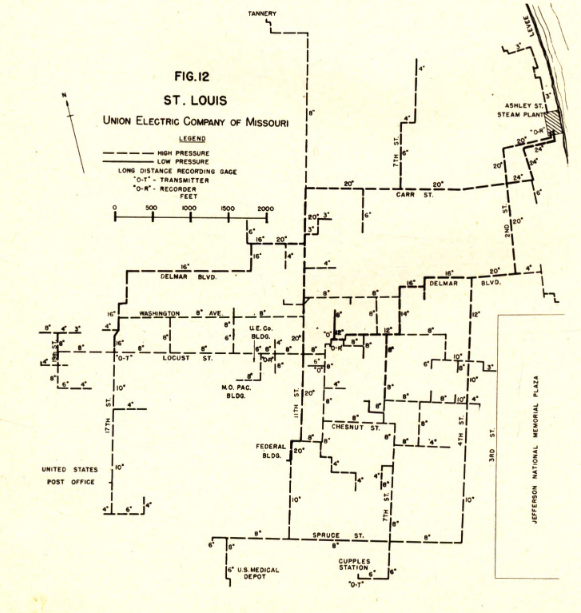
Pages 17: The district heating system operated by the Union Electric
Company of Missouri in St. Louis is essentially a high-pressure system.
Steam leaves the plant at approximately 200 psi and the average pressure
in the main is approximately 160 psi, from which it is reduced on the
customers premises to the specific pressure required.
The entire system is supplied by the Ashley Street Plant, formerly the
Company’s chief electric generating station. At present, this plant serves
as a reserve electric generating station in addition to supplying the
steam requirements. All steam delivered to the system is live steam.
Service is supplied to the downtown commercial and industrial
districts. The buildings served consist of office buildings, loft
buildings, hotels, factories, stores, warehouses, etc. Typical of the
larger customers are Southwestern Bell Telephone Building,
Missouri-Pacific Railroad’s main office building, and the St. Louis
Medical Depot.
The largest customer purchases approximately fifty million pounds per
year, while several small customers purchase as little as sixty thousand
pounds per year.
During the past three years many new customers have been connected to the
system and an active interest in district steam is evident from the large
number of inquiries received.
In the immediate area served, there is approximately as much additional
business to be secured as is now served. Supplying this additional
requirement, however, will necessitate considerable extension of the
distribution system and greater plant capacity.
The St. Louis arrangement of using the plant for the dual purpose of
supplying steam to the district steam system and as a stand by for the
electric system has proved to be economical and practical.
Page 142: Map of steam distribution system (as shown above)
1983 Thermal Resources of America, Inc. was incorporated in Ohio on February 10, 1983.
1984 "UE
Leaves Business of Steam Heat," St. Louis Post Dispatch,
December 5, 1984, Page 25E
Union Electric Co. went out of the steam heat business Tuesday, turning
its facilities over to the Bi-State Development Agency and Thermal
Resources of St. Louis Inc. The transfer is a first step toward a
"trash-to-energy" plant in downtown St. Louis, executives of Bi-State and
Thermal say.
The transfer came one day after the close of a $3 million sale of the
facility. With the change, the price of steam increased for the first time
in three years. It rose 6.4 percent - to $12.95 for each 1,000 pounds of
steam. After years of sharp increase, Union Electric froze the price
during negotiations to sell the system. The steam loop serves 266
buildings in an area bounded by Cass Avenue, 22nd Street, Chouteau Avenue
and the Mississippi River.
Bi-State owns the loop's 22 miles of pipes and related equipment. Thermal
owns the Ashley power plant, which produces steam. Thermal raised the $3
million privately for the sale. It prepaid Bi-State $1.9 million for rent
of the pipes; Bi-State then gave the money to Union Electric. Carl
Mathias, chairman of Bi-State's Board of Commissioners, said none of
Bi-State's money or credit was used in the transaction.
Initially, Thermal will continue to use oil to heat the steam-producing
boilers. It may convert to' coal if the firm gets enough customers and if
the price of oil rises, said Carl Avers, president of Thermal. Eventually,
a plant that uses trash to heat the boilers would be built just north of
downtown. It could process 900 tons of trash a day. Thermal is expected to
own the plant, executives said.
But ownership would depend on the way the $70 million facility is
financed, they said. Mathias said Bi-State should own the pipes because
the agency is the monopoly part of the system. A public agency is better
suited for that role than a private firm, he said. Executives said they
were uncertain when the "trash-to-energy" plant would be built. Avers said
the construction would depend on Thermal's ability to get more steam
customers.
1985 "Trash-Energy
Plant Financing Called Near," St. Louis Post Dispatch,
October 11, 1985, Page 6A
Thermal Resources of America, the parent company of the operator of the
downtown St. Louis steam loop, is close to getting a partner to financing
a "trash-to-energy" plant planned for north of downtown.
Carl Avers, president of the company, announced Thursday that Thermal had
reached a tentative agreement with Catalyst Energy Development Co. of New
York to handle the financing of the $70 million project.
The plant would burn refuse supplied by the city of St. Louis to produce
steam for the loop. The steam now is produced with oil-fired boilers in a
plant owned by Thermal Resources of St. Louis, a subsidiary of Avers'
company.
1986 "Merger Gives
Thermal Funds for Plant," St. Louis Business Journal, January 27,
1986, Page 20C.
Thermal Resources of St. Louis soon will have the money to begin
construction of its trash-to-energy facility and to expand its steam heat
market downtown as a result of its proposed merger with New York-based
Catalyst Energy Development Corp. Thermal Resources of America, the
Youngstown, Ohio,-based parent company of Thermal Resources of St. Louis,
merged with Catalyst Energy Dec. 31 and formed a new company called
Catalyst Thermal Energy Corp. that will be the main operating subsidiary
of Catalyst Energy.
1987 St. Louis
Business Journal, August 31, 1987, Page 1A.
before. In December 1985, Catalyst acquired the Thermal...America Inc.,
which operates steam heating systems in St. Louis and Youngstown,...
1988 "A Highflier's One
Final Gamble," The New York Times, March 30, 1988, Page D1
Perhaps the boldest is John D. Kuhns, founder and chief executive of the
Catalyst Energy Corporation, the largest of the new independent companies
that produce and sell electricity to utilities.
For instance, when Catalyst acquired a St. Louis steam maker, it kept free
of state regulations by not buying the steam pipes, instead persuading a
state agency to buy them and lease them back for $1 a year. Missouri law
exempts power producers that do not own their distribution channels.
1999 "District
steam and the St. Louis steam loop," by Tim M. Tierney and Harry J.
Sauer, Harry J, Jr., ASHRAE Transactions 105:1171
(1999):1171-1176. | pdf |
Page 1172: The St. Louis district steam system is actually a by-product of
this local electric industry. Its beginning occurred just after the start
of this century when there were many small electric and gas companies.
Each large building had its own boiler plant and generated its own
electricity, using exhaust steam from the steam engines for building
heating in winter. In effect, at many intersections, there were four steam
plants operating four electric generating units. The program to eliminate
individual electric generating plants and add those loads to Union
Electric's electrical distribution system was successful. It posed a big
problem, however, in that it left the young UE company with over a hundred
isolated steam power plants, leased for a nominal fee but with an
obligation to operate during the winter for building heating. Elimination
of these isolated steam plants started about 1910 and continued through
the 1920s. Initially, UE selected the most capable plant at an
intersection and connected the other three buildings to that plant's steam
generating system.
In 1911, the block bounded by Ninth and Tenth streets, St. Charles, and
Washington was connected to an original UE steam plant, known as 904 St.
Charles. Several buildings there, including the Wainwright and Arcade
buildings, were tied together with an underground main. These lines formed
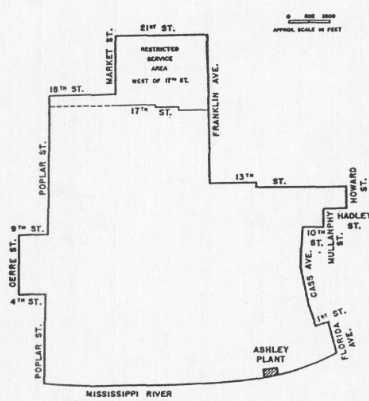
the nucleus of today's steam distribution system, which covers the area
shown above..
The steam system actually started to expand in 1924, when additional
electrical generating plants were added to the LIE system. This freed the
venerable Ashley Plant to supply steam to the heating system.
In 1924, the first main, a 20-inch pipe known as the west header, was
taken out of the Ashley plant and tied into underground steam distribution
lines being supplied from the isolated plants. The installation made it
possible to eliminate many of the old plants.
© 2026 Morris A. Pierce