|
Chronological List of District Heating
Systems in the United States |
The Northern Commercial Company built a combined heat and power plant in 1905 that began supply steam to local customers. The service was very popular and the system was expanded several times.
The system was sold to
the City of Fairbanks in 1952 and to the Aurora
Energy Company in 1998.
|
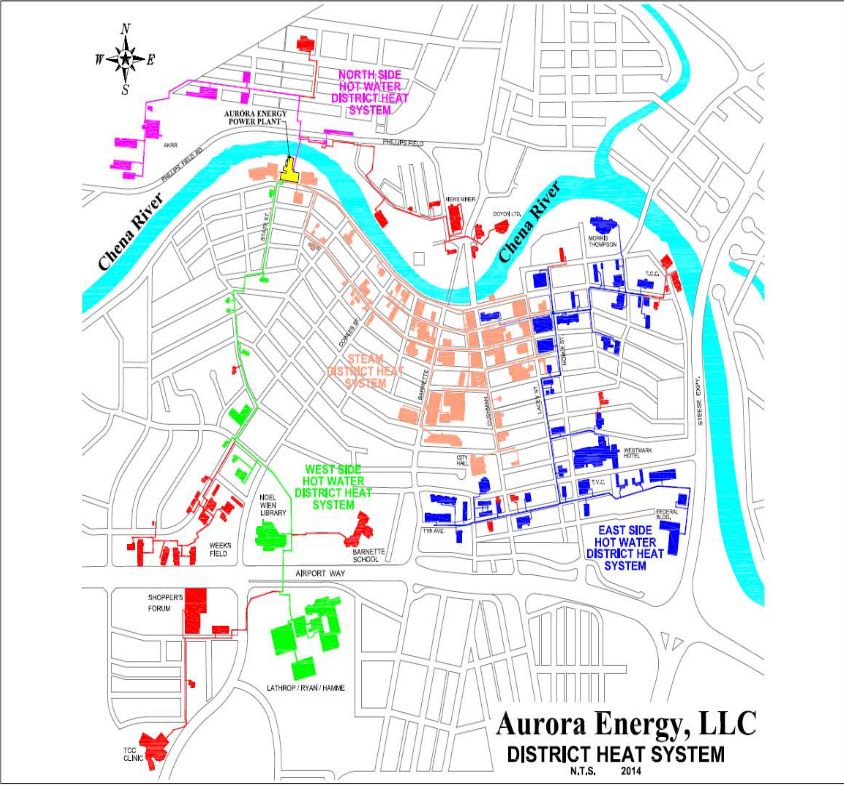
| 2014 Map of District Heat System |
References
1906 "Another
Boiler Working at the Big N.C. Plant," Fairbanks Daily Times,
October 22, 1906, Page 3.
Steam was got up for the first time in the big 83-horsepower boller at the
Northern Commercial company's heating and lighting plant yesterday. With
the addition of this boiler the big plant has now three batteries of steam
producers..
1907 The
Stroller's Weekly and Douglas Island News, September 25, 1907,
Page 1
The Northern Commercial Company will install the two largest boilers ever
taken to the Tanana, as a part of its municipal steam heating plant at
Fair-| banks. The company will extend its mains with the installation of
the new boilers and will have a capacity sufficient for every business
house in town as well as for many of the residences..
1947 "Northern
Commercial Company Supplies Steam in Fairbanks, Alaska," Bulletin
of the National District Heating Association 32(4):July 1947)
For the past fifteen years the business district of Fairbanks, an interior
Alaskan city, located on a branch of the Yukon River and on the Alcan
Highway, has been supplied steam by the Northern Commercial Company. This
is probably the only Alaskan community to have such service.
Steam for heating is taken from the turbines in the company’s electric
generating station at 7 psig and delivered to the customers through 8000
feet of mains.
About 2000 feet of 10 in., 8 in. and 6 in. steam lines and return lines
are installed in a concrete tunnel. This tunnel also carries the mains for
domestic water supply and fire fighting. The remaining steam and water
lines are in wood ducts filled with sawdust or shavings. The steam lines,
of course, are properly insulated.
The ducts are of such size as to permit at least 4 in. of sawdust around
the pipes. The water mains are carried in these mains to prevent freezing.
It really gets cold in Alaska. At Fairbanks the lowest temperature this
past winter was -62 F and there was a period of 16 days during which the
highest temperature was -50 F.
In all there are 225 customers, 90 per cent being business establishments
and the remainder residences. There are 270 days in the heating season.
The mean temperature for 43 years is 26.2 F. Annual steam sales is
estimated at 200,000 M lbs. The first block of steam sells at $ .80 per M.
Extensions to both generating plant and distribution system are being
considered.
William A. Schoel is manager of the utilities department of the Northern
Commercial Company.
1951 District
Heating Handbook, Third Edition, National District Heating
Association
Page 24: Alaska. District heating probably has received its
most severe test in Fairbanks, Alaska, where temperatures of minus 60 F
are experienced. The system serves the dual purpose of heating the City
and keeping underground water and fire mains from freezing. It is 8,000 ft
long and in 1945 served 225 customers a total of 200,000,000 lb of steam.
The steam, water, and fire mains are installed in the same duct thus
preventing the latter two from freezing.
1954 Flag
over the North; the story of the Northern Commercial Company
Pages 314-317: It was in the winter of 1903-04 , that Northern
Commercial made an installation that was to result in a power plant for
the city . To furnish the Company's own properties with the same efficient
electricity the Nome store had enjoyed , a 75-horsepower boiler and engine
were installed. Every one in town wanted to turn in kerosene lamps and the
Company was besieged with pleas to sell current. As a convenience to
nearby customers and neighbors, arrangements were made for 1,000 lights.
The demand was too great for the original capacity of the power plant . In
the summer of 1905 , increased to a " tremendous new capacity " of 240
horsepower and 3,000 electric lights , the modern 20th century facilities
marked a metropolis.
By May 1 , 1906 , the city's first fire pump had just been added to the
steam plant furnishing the power and to quote a city directory of 1907 it
" proved a Godsend during the great fire of May 22 , 1906."
After the fire, the plant was increased to 4,000 lights illuminating the
city. Boilers and engines rated 400 horse-power. Public demand for steam
heat and electricity was so out of hand by 1907, that Northern Commercial
with some $210,000 already invested in the utilities plant had to start a
reconstruction program to enlarge all capacities . Six thousand electric
lights were not enough.
The steam plant, last of the original "marvelous modern plants" was gone
by 1952. In 1951 , the city took over the distribution system of polelines
and piping. The generating plant consisting of boilers, generators, pumps,
switchgear and auxiliary and accessory equipment was sold to the Healy
River Coal Corporation in 1952.
1981 City of Fairbanks district heating development plan : summary report
1991 "Downtown Fairbanks Revitalized by Utilities," District Heating and Cooling 77(2):7+ (Fourth Quarter 1991)
2018 Aurora
Energy, LLC (powerpoint presentation)
© 2026 Morris A. Pierce