|
Chronological List of District Heating
Systems in the United States |
|
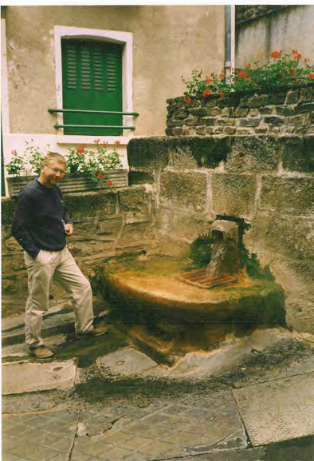
| District Heating historian Sven Werner visiting the geothermal source in Chaudes-Aigues in July 2000 (picture by his wife) |
The village of Chaudes-Aides in the Cantal region of France has had a geothermal district heating system since at least 1334, when it first appear in local tax records.
My daughter and I visited the village in the summer of 1995 and there was not yet a museum, which must have been built later. In fact no one in the village spoke English and we didn't speak French. My 1995 article (cited below) may have helped to bring attention to this important system.
References
1828 Essai
sur Chaudes-Aigues, département du Cantal: analyse chimique des eaux
minérales-thermales de cette ville, by Alphonse Chevallier
1844 Hand-book
for travellers in France, by John Murray
Page 415: The mineral waters from which it has obtained some resort as a
watering place are almost pure, warm water: they issue out of the slate
rock, and are 4 in number. That called Source du Par is the
hottest spring in Europe, except the Geysers in Iceland; having a
temperature of 177° Fahrenheit, and is one of the most copious sources in
France; the others, de Felgère, du Ban, and de la
Grotte, vary in heat between 135° and 162° Fahr. The waters are
taken in baths, and are drunk, being considered efficacious in rheumatism,
swellings of the joints, and some cutaneous disorders, though by no means
richly impregnated with mineral particles. They are also turned to various
domestic and economic purposes; they have the property of discharging most
rapidly the grease from sheep's wool, and a vast number of fleeces are
sent hither from the dept. Aveyron to be washed. From the month of
Nov. to April, the hot water is used for warming the town, being conducted
in pipes into some of the houses, called in the patois of the country Maison
Caoudo; and it thus saves the inhabitants the cost of many tons of
coal or whole forests of firewood: the equal distribution of the waters is
watched over by the police. The hot streams are also partly employed for
cookery, for boiling eggs, preparing soups, and scalding pigs. They have
also been turned to the artificial incubation of chickens with
considerable success.
1981 Chaudes-Aigues,
by Pierre Chassang | full text here
|
Chapter 26: Des eaux chaudes et leur usage de 1800 a 1939
1991 Les eaux de Chaudes-Aigues, by A. Chevallier (reprint of 1828 book cited above)
1992 "Chaudes-Aigues: historique des utilisations de la géothermie," P. Raynal, J.P. Gibert, and C. Barthomeuf, Réseaux & Chaleur 4(16):67-75 (1992).
1995 "The
road to Lockport: Historical background of district heating and cooling,"
by Morris A. Pierce, ASHRAE Transactions 101:885-892, Part
1; PB: 1517
Page 885: The first known use of hot water for heating is in the
village of Chaudes-Aigues in the Cantal region of France, where a
geothermal source was warming several houses by the early fourteenth
century and today provides heating for about 150 residences.
1999 "Using Geothermal Waters in France: The District Heating System of Chaudes-Aigues from the Middle Ages," Pages 287-305, Stories from a Heated Earth: Our Geothermal Heritage, by Jean Pierre Gilbert and Florence Juadin
2001 "Geothermal
District Energy System Analysis, Design and Development," by by R.
Gordon Bloomquist, Ph.D, International Summer School, Romania
Page 213: The delivery of thermal energy from a central source is
not a new idea. During Roman times, warm water was circulated through open
trenches to provide heating for buildings and baths in Pompeii. In the
ruins are the remains of the old heating plants, for example, the one used
in conjunction with the so called Thermer (bath). In many places it is
still possible to see how the heated water was circulated from home to
home through a network of trenches that went through the cellars of the
buildings. Hundreds of years later, but several hundred years before our
time, in Chaudes Aigues Cantal in France, geothermal water was distributed
as early as the 14th Century through wooden pipes. That system is still
used today. The French were already at that time utilizing a large main
with laterals to provide heat to individual houses.
2002 "Amélioration de la connaissance des ressources ne eau souterraine des sites thermaux en Auvergne – Site de Chaudes-Aigues (15)," by Bérard P, Loizeau M, Rouzaire D, Vigouroux P, Report BRGM/RP- 51722-FR, Bureau de Recherches Géologiques et Minières (BRGM) 2002.
2006 Modernité technique et valeur d’usage : le chauffage des bâtiments d’habitation en France, Volume I, Thèse présentée par : Emmanuelle GALLO
2011 "France
& Geothermal, 1334 to 2011," by Susan Fox Hodgson, Geothermal
Resources Council Bulletin 40(2011):1, 28-37
Page 34: 1334, The World's First District Heating System
2016 Photo album : here is what Chaudes-Aigues looked like a long time ago, Friday 09 September 2016
2021 Chaudes-Aigues: The first documented geothermal district heating system in France, 15/11/2021
2025 Moving
Heat and Cold: Concerning the First Steps in the Development and
Deployment of District Heating and Cooling, by Sven Werner
Pages 26-27: 3.1 Chaudes-Aigues, France since 1334
Located in the south of the Auvergne region, the village of Chaudes-Aigues
has around thirty thermal springs, with temperatures ranging between 45
and 82°C, together providing 700–750 cubic metres of hot water per day.
Chaudes-Aigues owes its name to this natural abundance of hot water.
Five of these hot springs are used to heat around 150 buildings in the
village during the heating season, which runs from mid-October to the end
of April. The heat is distributed through small street ducts and pipes,
with a total route length of 5 km. One major spring, called le Par, has a
temperature of 80–82°C and a flow rate of 500 cubic metres per day. This
spring is located just above the village square (Place du Marché), as
shown in the photo above. Next to the spring, a geothermal museum
called Géothermia was established in 1993. Apart from a pump that brings
hot water to the church, all circulation is by gravity, as the buildings
are located below the Par source. Outside each connected building, a
diverting plate – accessible via a hatch in the street duct – enables a
circulating flow of hot water to pass beneath the floor of each building.
This small geothermal system already existed in medieval times and was
commercial, as the village inhabitants had to pay for the use of hot
water. In the land register from 1332–1379, the first written mention of
hot water sales appears in a note from 1334. Three village residents were
in debt for their use of the hot water. The note states: ‘Guilhem
Valrus owes his landlord five sous for hot water that is found or to be
found in the public street between the house of Andrieu Brugier and the
house of R. Mercier and for the conduit. Guilhem de Rocha and St Fabre,
both at the square, must also pay five sous each, the first for the hot
water of the bath of his house, the second for the hot water of his
house’, according to (Raynal et al. 1992). This geothermal district
heating system has therefore been in operation for almost 700 years.
2026 The source of Par à Chaudes-Aigues, a major tourist curiosity, Friday, March 06, 2026
Museum of Geothermal Energy and Thermalism
© 2026 Morris A. Pierce