|
Chronological List of District Heating
Systems in the United States |
Baltimore Refrigerating and Heating Company reorganized as the Terminal Freezing and Heating Company in 1911. This company was bought by the Consolidated Gas Electric Light and Power Company of Baltimore in 1928 and was renamed Baltimore Gas and Electric in 1955. BG&E sold the steam system to Carl Avers and Catalyst Thermal Energy for $10 million in March 1985. Catalyst Energy contracted with a new waste-to-energy plant to buy steam for its system. This firm was renamed United Thermal in 1987 and was bought by Trigen in 1993, which in turn was bought by Veolia in 2007 and by Vicinity in 2019.
|
|
| 1938 System Map | 1951 System Map |
References
1902 "Make
Heat and Cold," The Baltimore Sun, July 9, 1902, Page 12.
The Baltimore Refrigerating and Heating Company was incorporated
yesterday.
1911 "New
Freezing and Heating Company Incorporated," The Baltimore Sun,
August 12, 1911, Page 12.
The Terminal Freezing and Heating Company, the successor to the Baltimore
Refrigerating and Heating Company, has been incorporated.
1928 "Control
Of Property And Business Of Terminal Freezing And Heating Co. Acquired
By Consolidated Gas Electric Light And Power Co.," The Evening
Sun, July 12, 1928, Page 35
The Terminal Freezing and Heating Company is a Maryland corporation dating
from August, 1911, and is a successor of the former Baltimore
Refrigerating and Heating Company. Has Supplied About 300 Customers The
Terminal Company's plant is located in the vicinity of Eutaw, Wayne and
Barre streets. Its heat distribution system comprises about 14,000 lineal
feet of main ranging from sixteen inches to six inches in diameter. It has
been supplying steam to some 300 customers.
1938 "Description
of Production Stations and Their Operation," Bulletin of the
National District Heating Association 23(3):127-140 (April 1938)
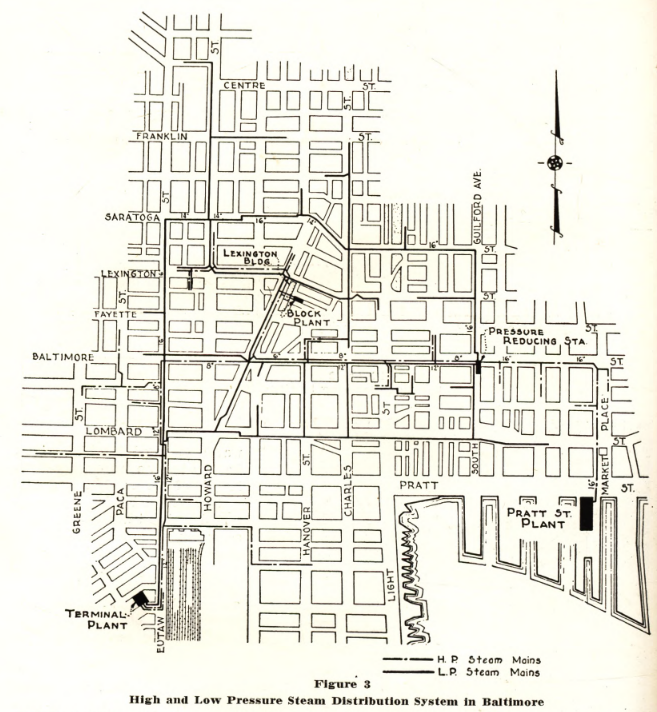
Page 134: Map of the steam system (as shown above)
1951 District
Heating Handbook, Third Edition, National District Heating
Association
Pages 16-17: District heating in Baltimore dates from 1901 when
Fentress and Midairy obtained a franchise and privileges to use public
highways to distribute refrigeration and heat. Heat was supplied during
the winter months and refrigeration primarily during warm weather. The
system was purchased from a successor company by the Consolidated Gas
Electric Light and Power Company of Baltimore in 1928, and since then only
steam has been distributed.
Service is furnished to the congested commercial and semi-industrial
section of downtown Baltimore. It is served by two principal plants. One
was erected especially for steam service; the other is a reserve electric
plant but is used primarily to supply steam to the district heating
system. These plants are supplemented by several small plants which are
used during peak load periods and for reserve.
Service to the commercial district is supplied through a low-pressure
distribution system with pressures ranging between 8 and 20 psi. This
system is operated eight months during the year. A single high-pressure
line operating at a minimum of 125 psi is installed through the
approximate center of the low-pressure district and connects the two
plants. If furnishes the high-pressure requirements of the larger
buildings and industrial customers throughout the year. Branch mains from
this high-pressure line supply the semi-industrial area.
Steam is used principally for space heating but process steam is supplied
for cooking, water heating, brewing, and the manufacture of clothing,
hats, medicine and candy. It is also used to supply the many requirements
in hospitals and hotels.
Most of the important buildings in downtown Baltimore are served,
including the main offices, station and yards of the Baltimore and Ohio
Railroad Company, the Medical, Dental, Pharmacy and Law Colleges of the
University of Maryland, and the University Hospital. The service which has
been vigorously promoted, enjoys a wide demand and over one thousand
customers were using it in 1949. Revenue increased 188 per cent during the
sixteen years preceding 1949.
The distribution system covers an area where steam can be supplied
economically and no expansion of this territory is contemplated for the
near future.
The dual distribution system in Baltimore permits lower pressures in the
main distribution system and makes it possible to turn off the
low-pressure lines during the non-heating season. The much smaller
high-pressure system supplies high pressure and year round requirements.
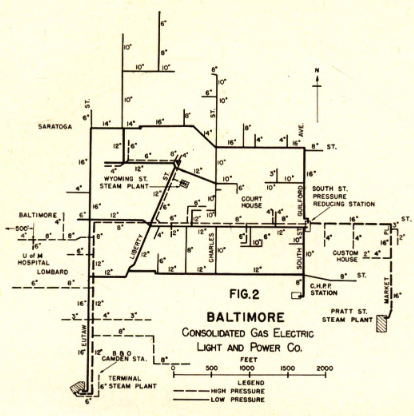
Page 134: Map of the steam system (as shown above)
1985 "BG&E
finishes sale of city steam system"' The Baltimore Sun,
March 2, 1985 Page 30 | Part
2 |
The new owners of the system plan to build a connection to the Baltimore
Refuse Energy Systems Company's trash-to-energy plant on the east side of
Russell street, which will sell steam to the new company under a long-term
contract. The BRESCO plant, which went into operation last September, is a
few blocks west of the two steam generating plants BG&E sold. Mr.
Avers said the new company expected to be getting steam from BRESCO
"within about six months." The two generating plants are the Terminal
Plant, which has six boilers, and the Spring Gardens Plant, which has
eight. Both are in South Baltimore.
1986 "Stadium move to Camden Yards would force 20 firms to relocate," The Baltimore Sun, December 6, 1986, Page 8
1987 "Steam
Firm Changes Name," The Baltimore Sun, July 21, 1987, Page
36
Baltimore Steam Co. has changed it name to Baltimore Thermal Energy Corp.
1993 "French
Buy United Thermal," The Baltimore Sun, December 8, 1993,
Page 18D.
United Thermal Corp., parent company of the Baltimore Thermal Energy
Corp., has been sold to the French-owned Trigen Energy Corp. The purchase
price was not disclosed. The local operation, which provides steam to
various buildings in Baltimore, will now be known as Trigen-Baltimore
Energy Corp..
© 2026 Morris A. Pierce