|
Chronological List of District Heating
Systems in the United States |
Virginia established a water and light commission in 1913, which prepared a report on the installation of a central heating plant the following year. The city approved the plan, but the outbreak of World War I made the required materials and labor were unavailable The plan was pursued after the end of the war and began service in late 1919. Until 1929 most of the steam was purchased from a local lumber mill at a favorable cost.
This system is unique as it is the only one in the United States the serves the entire city (or nearly all of it). Rising costs forced the abandonment of residential service in 2020 and the entire system will be shut down in October 2026.
|
|
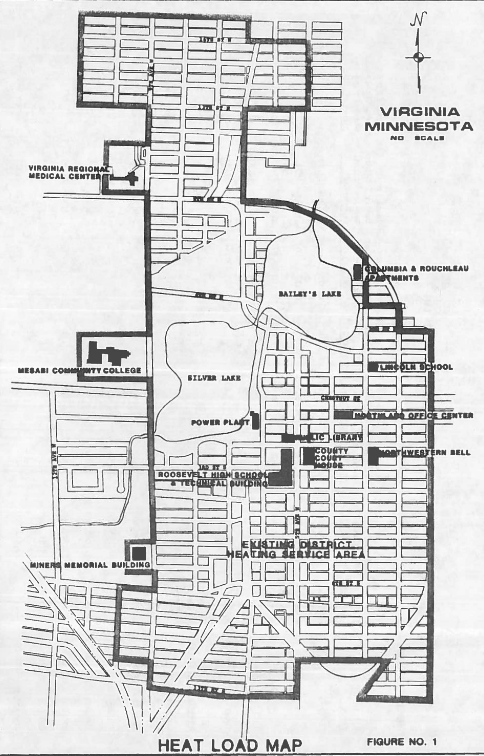
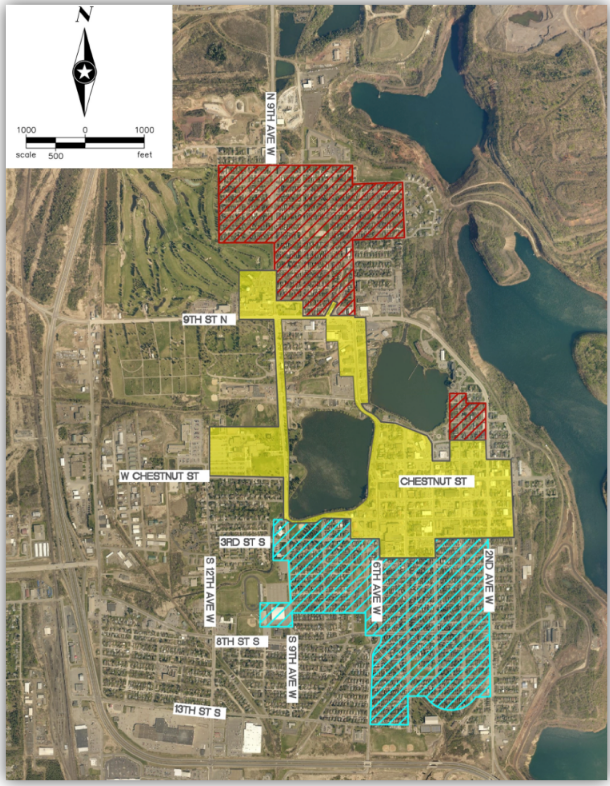
| 1986 Heat Load Map | 2017 Virginia District Steam System and conversion areas |
References
1905 Western
Electrician 36(20):398 (May 20, 1905)
The City Council of Virginia is considering a proposition from the
Virginia Light and Water Company for the purchase of its plant at about
$70,000.
1914 "The
City Council," The Virginia Enterprise, July 27, 1914, Page
5.
The water and light commission submitted a lengthy report on the matter of
installation of a central heating plant in this city to furnish steam for
heat in buildings located on certain streets and avenues, without
recommendation, simply a plain statement of the cost of installation and
operation of the plant.
1921 "Virginia,
Minn.," The Heating and Ventilating Magazine 18(1):78
(January 1921)
The controversy regarding payment of the Virginia municipal heating
system, which has held the center of local interest for the past six
months, is due for settlement in the near future, according to members of
the board of appraisers, now completing a survey of the tax levy list as
prepared by the water and light commission.
The history of the heating system extends back to the first days of the
war. The citizens were eager for the service, and agreed to pay entire
cost for its equipment and installation. A resolution to that effect was
passed by the city council. It was found that during the war the materials
and labor could not be secured, and consequently the plan was discarded
for the time being, but with the coming of peace the demand was more
urgent than ever and the council finally agreed to go ahead. Contracts
were distributed, and practically all property owners signed.
The water and light department was instructed to rush the work to
completion so that the service could be in use for the winter of 1919. The
city advanced the money on the understanding it would be repaid one-tenth
for the next 10 years, this to cover the distribution system, while rates
for steam were to be set at a point to give sufficient profit to pay for
the central heating plant in the same period.
Last winter the system was in use. There was some difficulty regarding
high charges, but these were straightened out by midwinter and all
consumers expressed delight with the system. When the question of placing
the assessment on the tax levy, however, one group started the agitation
that the heating system is to be extended. and residents in other parts of
the city will receive service from the main lines, without helping to pay
for the initial cost. From this grew a determined effort to force the city
to pay for the intersections, and other items of the cost.
These demands brought on some heated controversies in the council
chambers, but ended in the appointment of the heat appraisers, and
expression of a determination to go ahead and include the cost of the
system in the tax levy.
1921 Sanborn
Fire Insurance Map from Virginia, Saint Louis County, Minnesota,
November 1921.
Plate 6: City Water Works, Heating & Light Plant.
1925 Bulletin
of the National District Heating Association 11(1):63 (October
1925)
Virginia, Minn. This was listed as a hot water plant with the rate charged
at 60c per sq. ft. of radiation and should be listed City of
Virginia-Steam-Serving 74 blocks with radiation load of approximately
600,000 sq. ft., rate 65c per 1000 lbs. of condensation less 5c per M cash
discount for prompt payment. A large part of the time steam is taken from
the Rainy River Lumber Company's sawmill which is the largest in the
United States and is located only a short distance from the power plant.
This mill operates day and night and burns mill refuse for fuel. The city
purchases this steam at a low rate.
1930 Bulletin
of the National District Heating Association 16(1):69 (October
15, 1930)
Virginia, Minnesota. (Water and Light Commission) Serving about
75-city blocks with a radiation load of 750,000 sq. ft. The rate at the
present time is 65 cents per thousand pounds condensation less 5 cents per
thousand pounds cash discount for prompt payment.
Generating all our steam at our own plant as the Virginia & Rainy Lake
Lumber Company discontinued saw mill operations in October, 1929, and we
have been generating all steam from our own plant since that time.
1944 "Municipal
Central Heating System Serves Whole City," Engineering News
Record 133:79 (December 28, 1944)
First and only city in, the country where a central heating system
provides heat for the entire population is Virginia, Minn. In that
community all homes, stores, schools and churches are served from steam
mains running through every street in town, temperature in the individual
houses being controlled by a thermostat in each.
The system is municipally owned and operated as a non-profit enterprise.
Cost figures are especially interesting because of the community's
location in northern Minnesota, where winter conditions are severe.
The plant is said to burn 43,000 tons of bituminous coal a year, at a cost
of $7 per ton. The average house-holder occupying a 5-room house pays $70
a year to heat his house and hot water, about half the cost for heating on
an individual basis. Differing ability of the householder to economize and
properly operate his heating system naturally results in variations from
this average.
In addition, the steam is first used to generate electricity before it is
piped into homes and business establishments, the community profiting
through this auxiliary use of the central plant. Lower cleaning bills,
less laundry and fewer colds are some of the incidental benefits that have
resulted from the virtual smokelessness of the city since the central
plant's establishment. Also, the refuse collection problem has been
simplified by the elimination of ash receptacles, and fire losses in
dwellings are said to he 40 percent lower than formerly.
1951 District
Heating Handbook, Third Edition, National District Heating
Association
Page 23: Virginia, Minn. Virginia, Minnesota, with a population of
13,000, is of particular interest in that it is probably the only
community in the country wholly served by a district heating system. The
service is combined with that of supplying electricity, water, and gas.
Service was originally supplied to the City by a lumber company which
burned saw-mill refuse. The saw mill was shut down after several years and
the supply of cheap fuel was no longer available. The City, however,
substituted a coal-burning plant and the district steam system was
expanded. The present system consists of a generating plant containing
extraction-condensing turbines for generating the electric-power
requirements of the City as well as supplying a portion of the steam used
for heating. The greater portion of the heating steam, however, owing to
the size of the heating system, is supplied directly from the boilers.
The total investment in outside distribution mains is about
$810,000. The investment in boiler-plant and steam-generating
equipment chargeable to the Steam Heat Department is $400,000. Because
extensions are financed by assessments to the houses benefited, the
municipality has no direct financial interest in the outside mains. The
system covers practically the entire city with the exception of some
outlying section where, at present, it is not practical to extend the
lines because of transmission losses.
Main extension cost is assessed against benefited property on the basis of
a ten-year special assessment, payable to the City to be credited to the
sinking fund for bond retirement.
Steam is supplied to several large office buildings, public buildings and
schools, the city hospital, and residences.
The revenue from the sale of steam is intended to defray the cost of
operating and maintaining the plants, plus a reasonable amount for
depreciation.
It is not the desire of the officials to make profits to build up a large
reserve.
The success of this system can be attributed to the fact that in the early
days, low-cost steam was obtained from the saw mill, and that the City has
so developed that for the most part it is possible to distribute the steam
in a more or less densely built-up area with the generating plant
centrally located.
1959 "Virginia, Minn.," District
Heating 44(3):112 (January 1959)
On petitions of 50 percent of the residents, steam extensions are started
by the city commission. Last October the extension of steam service
to Lencis' Third addition was being discussed. For the block
mentioned the assessment was $15.62½ per foot based on the costs.
1981 "A Transition from Steam to Hot Water: Virginia, Minnesota," by Edward J. Kozan, Proceedings of the Annual Conference of the International District Heating Association 72(19):1-17 (June 1981)
1985 "District
Heating in Minnesota," by Tom Hughes, Minnesota Cities
70(12):8,9 (December 1985)
Page 9: Virginia is known for having one of the largest residential
district heating systems in the world, serving 3,120 customers. But, it is
also one of the oldest systems, and steam regularly escapes through
worn-out pipes up into the streets. The top priority for the Virginia
study team was to determine the feasibility and cost of converting the
existing steam system to a hot water system. Economic analysis of
alternatives is still in progress and a final report will be complete
soon.
1986 "Planning for Conversion to Hot Water: World's Largest Residential Steam District Heating System. Virginia. Minnesota," by David C. Rian, Proceedings of the Annual Conference of the International District Heating and Cooling Association 77:387-403
2017 "Steam Conversion," December 19, 2017, Virginia Public Utilities Commission
2024 "Virginia
to eliminate steam by late 2026," Mesabi Tribune, January
27, 2024, updated March 2, 2025
The steam heating system in Virginia will be downsized once again, and
ultimately eliminated late in 2026, according to a plan put together by
the Department of Public Utilities.
This time it will be the final 200 steam customers remaining on the system
in the downtown core district. That includes the area around Chestnut
Street and a line to the hospital and two businesses that feed off of
that, DPU General Manager Greg French said in a phone interview.
The Virginia City Council shared the news Tuesday night.
“The public utilities will no longer provide steam heat to customers after
Oct. 31, 2026 and they plan on implementing the same conversion program as
they utilized in the past,’’ Public Utilities liaison and Councilor Liz
Motley told the council at Tuesday’s meeting.
Mayor Larry Cuffe Jr. said he talked to French and found out the same
conversion plans and offers will be used for the core district, just like
what was done for the previous steam conversions in recent years on
Northside and Southside.
The biggest obstacle, Cuffe said, is the cost of conversion in the
business district, particularly in larger buildings like the Tini Square
Building, Lincoln Building, City Hall, utility garages and buildings and
Washington Manor.
The utility will assist those converting financially in a few ways, French
said.
The utility will install the gas service for free. Loans at 0% will also
be made available for 10 years or up to 15 years for higher cost
conversions. If those converting don’t want to take out the loans, the
utility will offer them a rebate check equal to 75% of their 2023 steam
costs, he stated.
With the steam system down to the core district, the utility put in
high-efficiency units in recent years before assessing the financial
feasibility of keeping steam in that area, according to French. “The
financials just are not making it.’’
Looking at the 2024 budget, the general manager said the net income on
steam itself is at about a $4.6 million loss. Taking away the income from
electricity and other commodities, the loss gets down to a $2.1 million
net loss.
That converts to 4,800 customers without steam are subsidizing the
remaining 200 that do use steam, French said. The core district conversion
is needed even though the utility has Laurentian Energy Authority funds
available from the Xcel Energy buyout. Action has to be taken now, he
said, or major utility hikes will happen when that runs out in about 4-5
years, he added.
The notification to DPU customers will happen soon, according to French.
Some on the council had questions about the planned core district
conversion.
“I would like to address part of my concerns regarding the overall
commercial steam conversion and the high rate of cost that it will
involve. Actually just sitting here talking, it may also include
electrical upgrades and I think there needs to be a coalition group formed
or a task force group formed,’’ said Councilor Julianne Paulsen.
“The Public Utilities dictates the steam, but the city of Virginia has an
obligation to not only its downtown but our economic development. I feel
that there needs to be some representation from VEDA (Virginia Economic
Development Authority), from this council body, as well as the IRRRB (Iron
Range Resources and Rehabilitation Board), And I do not feel the Virginia
Public Utilities should be making this decision on their own. I think that
we should form a larger coalition’’ … “because I think this issue is very
serious and I have some specific ideas on how I think that it could
possibly be handled.’’
“I share your frustration Councilor Paulsen,’’ Councilor Steven B. Johnson
said. “I’ve been asking since they first came to us and said we’re going
to be converting half of Virginia. What’s the plan, what’s the plan,
what’s the plan. It frustrates me greatly all of a sudden it’s two years
and done. There are several businesses that have been asking this question
for several years and getting nothing.’’ “Definitely there needs to be
some serious communication.’’
A
History of Virginia’s Public Utility
The Early Foundations of the Steam District
In 1919 Virginia’s school district was planning for its third expansion of
its technical building and for the eventual building of the Roosevelt High
school - completed in 1928. Part of that planning involved the need for a
heat plant sufficient to heat those buildings. Working with the
Department, the school district paid for the installation of two boilers
(518 HP Heine) and a 175 foot stack, and it was agreed that the Utility
would operate them on the school’s behalf. But, at this time, agitation
began for extension of the district steam heating system beyond the
downtown business district. The Department reluctantly consented to this
and, as a result, decided it needed to take over the ownership of the
school’s boilers in order to effectively operate such a steam district.
Consequently, the year following the installation, 1920, the Utility
reimbursed the school for the cost of the boilers. In addition, in 1921
plans were made to purchase two additional boilers (778 HP Heine) to
support the initial build-out of the residential steam system.
Positioning the Utility for Growth
In 1922 the old plant was dismantled and the new #1 steam plant was built.
Installed in this new building were the two boilers purchased in
cooperation with the school district, the two new 778 Heine boilers
contemplated above, and two 1,000 kw Allis-Chalmers condensing
turbine-generator sets along with all auxiliary equipment. There was some
concern about the department’s dependence on the mill plants for the
production of steam. Thus, in 1923-1924, two additional boilers (773 HP
Kidwell), were installed in the new power plant building – which had been
originally built to accept such an expansion. Also during this time the
expansion of the Steam Heat district continued with the construction, in
1921, of Steam Heat Zone #2, Zone #3 in 1923, Zone #4 in 1924, and zone #5
in 1925 bringing the total size of the steam district to 78 blocks. With
this expansion steam heat was available to nearly all residents "south of
the bridge."
The ‘30’s Bring Slow and Steady Growth
In 1930 the generating capacity lost by the removal of the Virginia and
Rainy Lake turbine was replaced by the installation of 1,500 kw
Westinghouse turbine. From the 1930’s through to the end of WWii there was
slow growth in demand for electricity. The installation of a 2,500 kw
turbine (General Electric) in 1937 increased the Department’s generating
capacity and provided some measure of back-up. Also, during this time,
steam district expansion continued with the installation of steam zone 6
in 1930, Zone 7 in 1935, Zone 8 in 1937, Zone 9 in 1938, and Zones 10 and
11 serving Northside in 1940 and 1941.
The Steam Department’s Final Reach
With the rezoning of the Virginia and Rainy Lake mill site and the boom of
the 50’s, housing expansion occurred in what is now called the Veteran’s
Addition and the Lenci Addition. The Utility expanded its steam system
along with that growth with the final expansion into the Lenci additions
in 1956.
Continued Growth in the Electric Demand
In 1950, with the rapid electric load growth, the Utility was again faced
with the need for further expansion. This program, completed in 1955,
included remodeling of coal handling equipment, a new plant building
addition, a 90,000 pph boiler (our current #7 boiler), and a 7,500 kw
turbine generator unit (our current # 5 turbine), with all necessary
auxiliaries and controls. Again in 1960, contracts were let for a new
150,000 pph steam boiler (our current #8 boiler). This additional high
pressure boiler would furnish adequate high pressure steam to run the
7,500 kw and the 5,000 kw turbine at full electric load and full
extraction of steam for the city heating system.
The Beginnings of the Minnesota Power Relationship
The failure of #1 turbine generator, in 1963, resulted in the purchase of
1,047,600 kwrs of electricity from Minnesota Power & Light. Although
there had been, previously, some minor purchases of electricity from
Minnesota Power & Light, this purchase was the beginning of a
relationship spanning through to the current time. There was a realization
that Minnesota power & light could serve as a source of standby power
in the event of operational failures. And so, from the early 60’s
through the 70’s purchases from Minnesota power remained roughly 10% of
the total kwhs required. However, through the 80’s purchases rose to 25%
of the load; then to 40% of the load in the early 90’s, and to 50% in the
late 90’s. Thus over 35 years there came about a transition from a
municipal utility focused primarily on producing power to meet the city’s
power needs and secondarily for city steam needs, to being primarily
operated to meet the needs of the steam system with electric power needs
being secondary.
Natural Gas’s Introduction to the City
In 1964 the Federal Power Commission granted Northern Natural Gas
permission to extend its natural gas pipeline to the Range area. Thus, the
conversion of the gas system from reliance on manufactured gas produced
(from coal) at a gas plant on the southern outskirts of the city to a
natural gas operation was completed November 30th, 1965. Unlike today,
natural gas was not thought of as a home heating fuel. Furthermore, steam
customers were generally pleased with their heating systems and there was
extremely limited capacity to flow natural gas to the city. Consequently,
as people abandoned their gas stoves and hot water heaters for cleaner and
cheaper, electric alternatives, the number of gas customers plummeted
through the 60’s and the 70’s reaching its low point of 528 in 1985.
Consolidation and Retrenchment of Gas Department
Interestingly, the availability of natural gas in 1964 did little to
change the outlook for the gas department. Residential natural gas heating
was a relatively new phenomenon. Throughout the early 80’s large portions
of the gas distribution system were abandoned in an effort to reduce the
gas lost through leaks. At the same time replacement of deteriorating gas
mains and services with plastic piping was completed in Williams Addition,
Sunset, Alpena, and part of Lenci additions - areas of town where, for the
most part, steam service did not exist. From the late 80’s and throughout
the 90’s there was continuous expansion/ replacement of old steel gas
mains with new polyethylene pipe. Much of this work was done in parts of
town where steam existed. Thus, while the number of gas customers had
fallen to a low of 528 in 1985, it was this steady program of rebuilding
the gas system and essentially overlapping it with large swaths of the
steam system that began the rise in natural gas services and a decline in
steam services.
The Aging Steam System: What to Do About It:
Beginning in the late 60’s the Utility began experiencing repeated losses
primarily due to the deterioration of the distribution system which caused
enormous amounts of steam losses, but also due to the ever increasing cost
of fuel. A series of rate increases provided temporary relief, but despite
these, the bottom fell out in the early 1980’s with repeated operating
losses in the $400,000 range. At its peak in the early 60’s the system had
more than 3,000 customers. In the late 70’s that was still the case. But
the price of steam had lost its attractiveness. Electric Heating was
coming of age and natural gas heating was not long from becoming a viable
alternative. In 1986 considerable thought was being given to conversion to
a proposed hot water system, but in 1987 this idea was abandoned with the
more prudent solution being a systematic repair and rebuild of the
existing system.
The Challenges of the Steam Department
The 80’s had seen the beginning of a decline in the number of steam
customers. From nearly 3,300 in 1979 there was a steady decline so that by
1998 there were 2637 customers. In November of 1999 the commission adopted
a resolution to abandon certain areas of the city steam system effective
in 2002. Gas projects for that year included extension of natural gas to
customers in the phase i (generally Lenci and Olcott additions and the
east side of 2nd Avenue from 3rd Street South to 12th St. S.) and Phase II
(Veterans Addition and Southside beyond 8th St S) areas to prepare for the
eventual conversion of those areas from steam to natural gas. This
conversion was halted for the most part after the end of Phase I largely
due to pressure from steam customers and their acceptance of a $25 per
month commodity charge. Currently the utility has 1,736 steam customers
and 1,878 gas customers.
A New Era
And so it was, after the accumulation of one problem after another, that
the Utility found itself floundering at the turn of the century. Power
plant capacity had not kept up with growth and there came to be a heavy
dependency on Minnesota power to meet the power needs of the city. The
newest turbine was nearing 30 years old. The newest boiler was rendered
financially unoperational. Another of the Utility’s boilers (#8) was shut
down as a result of environmental regulations. The Department’s power
facility had, in essence, become a steam production plant for its aging
steam system.
.
© 2024 Morris A. Pierce