|
Chronological List of District Heating
Systems in the United States |
Pittsburgh has had three steam heating systems. The first was the Bellefield Boiler Plant, which opened in 1907 to serve the new Carnegie Library and has since expanded to serve several other institutional customers in the area.
The second was the Allegheny County Steam Heating Company, which was incorporated on September 14, 1912. Its parent, the Duquense Light Company had bought the Phipps Power Plant at 120 Cecil in May 1912 and used that plant to start a larger steam network. The system was sold to the Pittsburgh Allegheny County Thermal cooperative in 1983, which was sold to Cordia in 2022. The former Phipps Power Plant is being converted in 97 housing units.
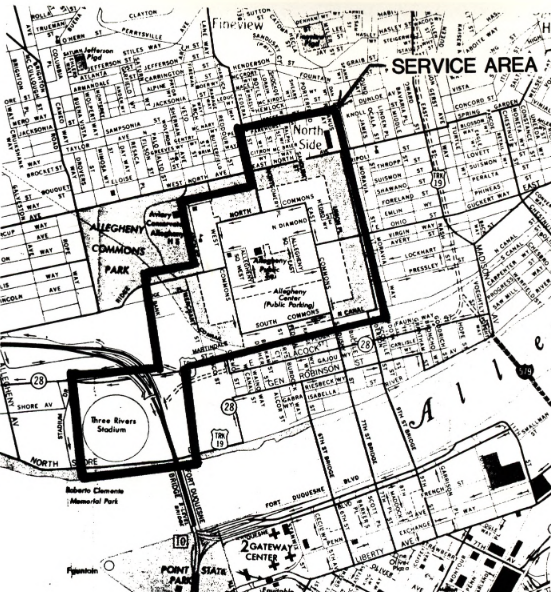
The third was the Equitable Gas-Energy system which began service in 1966 and was sold to Thermal Ventures in 1990, then to NRG Energy in 1999 and to Cordia in 2022
|
|
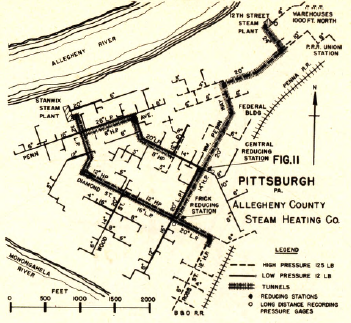
| 1951 System Map | 1987 Map of Equitable Gas System Service Area |
1903 "To
Be Monster Power Plant," The Pittsburgh Post, January 27,
1903, Page 11.
The Phipps power plant will be a 10- story brick and steel building and
will stand in Cecil alley, 120 feet from Duquesne way, occupying a plot
100x100 feet. It will be the central power plant for all the buildings on
Phipps grounds in that section of the city. The plant will be the largest
private plant In Pittsburg, and the finest and one of the largest In the
country. It will be fitted at first with a 3,800-horse power plant, the
contract for the mechanical equipment having been let some months ago.
There will also be a slightly smaller capacity of engines and electric
generator. When finally equipped it will be a power plant. The power will
be used for lighting, heating. operating elevators, ventilators, etc., in
all Mr. Phipps' buildings now being erect• ed and to be built in that
portion of the city.
1905 Sanborn
Fire Insurance Map from Pittsburgh, Allegheny County, Pennsylvania,
Volume 1.
Plate 3: Phipps Power Plant on Cecil Place.
1906 "Mechanical Equipment of the Carnegie Library Extension, Pittsburgh, Pa.- Part I," The Engineering Record 54(16):436-438 (October 20, 1906) | Part II | Part III | Part IV | Part V | Part VI |
1912 "Power
Plant Equipment Bought by Light Co.," Pittsburgh Post-Gazette,
May 16, 1912, Page 10.
Transaction involves Machinery and Contracts Held by Phipps Company. The
Duquesne Light Company has purchased from John S., Henry C. and Howard
Phipps the Phipps Power Plant equipment installed in the 10-story building
in Duquesne way, near Sixth street. The real estate is not involved
in this sale, which was closed yesterday by Lester E. Larned, secretary of
Eugene S. Reilly & Co.
The transaction involves not only the machinery, but the contracts held by
the Phipps interests for supplying electricity for power and light to
theaters, stores and skyscrapers in that section of the city. In addition
to securing these contracts, the Duquesne Light Company acquires a long
lease on about half the space in this 10-story building, all the
machinery, etc., being purchased outright.involves Machinery and Contracts
Held by Phipps Company. The Duquesne Light Company has purchased from John
S., Henry C. and Howard the Phipps Power Plant equipment installed in the
10-story building in Duquesne way, near Sixth street.
1912 "Charters
Issued," The Star-Independent, September 14, 1912, Page 7.
Allegheny County Steam Heating Company, Capital stock $50,00
1932 Handbook
of the National District Heating Association
Page 15: Pittsburgh, Pennsylvania. The Allegheny County Steam
Heating Company operates a district-heating system in the downtown
district. Two active steam generating plants contain a total of four
boilers; one small plant is held in reserve.
The company serves 259 customers having 3,154,000 sq. ft. of equivalent
direct radiator surface and an equivalent heating volume of 268,000,000
cu. ft. of space. In 1930, 1,339,838,000 lb. of steam were sold. In
general, consumers are served with steam at a pressure of 10 lb., but many
of the more recently connected customers are served directly from piping
in which a pressure of approximately 125 lb. per sq. in. is maintained.
The principal steam pipes are installed in tunnels along with the
condensation return piping. The buildings served are mainly large office
buildings, large department stores, and hotels. No industrial plants are
served, but a number of customers operate restaurants and laundries with
steam taken from the district-heating system.
1947 "Bellefield Boiler Plant Continues Expansion," Roger B. Spellman, Power Plant Engineering 51(5):111-116 (May 1947)
1951 District
Heating Handbook, Third Edition, National District Heating
Association
Pages 19-20: Pittsburgh. Over 450 customers in an area no
larger than one-half square mile are supplied with steam produced by the
Allegheny County Steam Heating Company, a subsidiary of the Duquesne Light
Company.
The distribution system supplying service to Pittsburgh’s downtown area,
known as the “Golden Triangle,” is in reality a combination of high and
low-pressure systems with interconnections. Steam is available at 10 psi
to all customers, and high pressure, ranging up to 125 psi, is available
to many. The distribution system is served by two main plants and one
small reserve plant, all of which generate only steam.
Since the district served is essentially commercial, very little steam is
utilized for industrial purposes and none for residential. Most of the
steam is used for heating buildings, although a substantial year-round
load is supplied for water heating, cooking, laundering, and food
processing. Customers range in size from the very small store owner who
pays $40 per year up to the largest consumer the revenue from whom is
approximately $100,000 annually. Among the customers are one of three
newspaper plants, seven of nine hotels, nine of ten department stores,
nine of twelve theatres, all seven five-and-ten-cent chain stores, and
both railroads, including their yards. Nearly all major office buildings,
including federal, state, and local governmental buildings, the Mellon
National Bank and Trust Company Building, and the Grant Building are also
supplied.
In the territory adjacent to or near the Company’s lines, approximately 80
per cent of the total steam requirements of all establishments are
supplied. This represents about 60 per cent of the total number of
potential users. While these figures indicate that some valuable new
business is available near existing lines, the saturation point is rapidly
approaching. There are no^ immediate plans for expansion into new
territory, either remote from or adjacent to the present area, but it is
apparent that continued growth will necessitate extension into new areas.
Since the two rivers, form a natural barrier for expansion to the north,
west, and south, the logical move is to the east, where more industrial or
semi-industrial business may be obtained.
1967 "Bellefield Boiler Plant," by Louis M. Susany, District Heating 52(3):91-99, 102 (Winter 1967)
1967 "Modern Gas Sets the Climate at Allegheny Center," by William F. Goffe, Jr., Equitable Gas-Energy Company, Pittsburgh, Pennsylvania, Proceedings of the Annual Conference of the National District Heating Association 58:29-36 (June, 1967)
1982 "Cooperative to Run Steam-Heating Firm," The Pittsburgh Press, March 18, 1982, Page 1 | Part 2 |
1987 "The
Equitable Gas-Energy System, Pittsburgh, Pennsylvania," District
Heating and Cooling 73(2):13-15 (Fourth Quarter 1987)
Operation of the plant began in 1966 with the initial construction phases
of the urban renewal project.
1994 "Thermal Ventures Pursues Growth Plans in San Francisco, Pittsburgh, Youngstown," District Energy 80(2):10-13 (Fourth Quarter 1994)
2016 "The
State of Steam," Pittsburgh Post-Gazette, April 19,2016,
Page D3 | Part
2 |
Three regulated steam energy plants in Pennsylvania.
2023 "A Steam Pipe Dream," Pittsburgh Post-Gazette, June 4, 2023, Page 1 | Part 2 |
2023 "Peoples sells direct energy assets," Pittsburgh Post-Gazette, October 4, 2023, Page A14 | Part 2 |
2025 "Former
Boiler Plant's Conversion OK'd," Pittsburgh Post Gazette,
July 2, 2025, Page A1 | Part
2 |
Project to yield 97 Downtown housing units.
© 2025 Morris A. Pierce